What Is AI Performance Engineering?
How autonomous AI agents are replacing manual load test scripting with minutes of agentic automation.
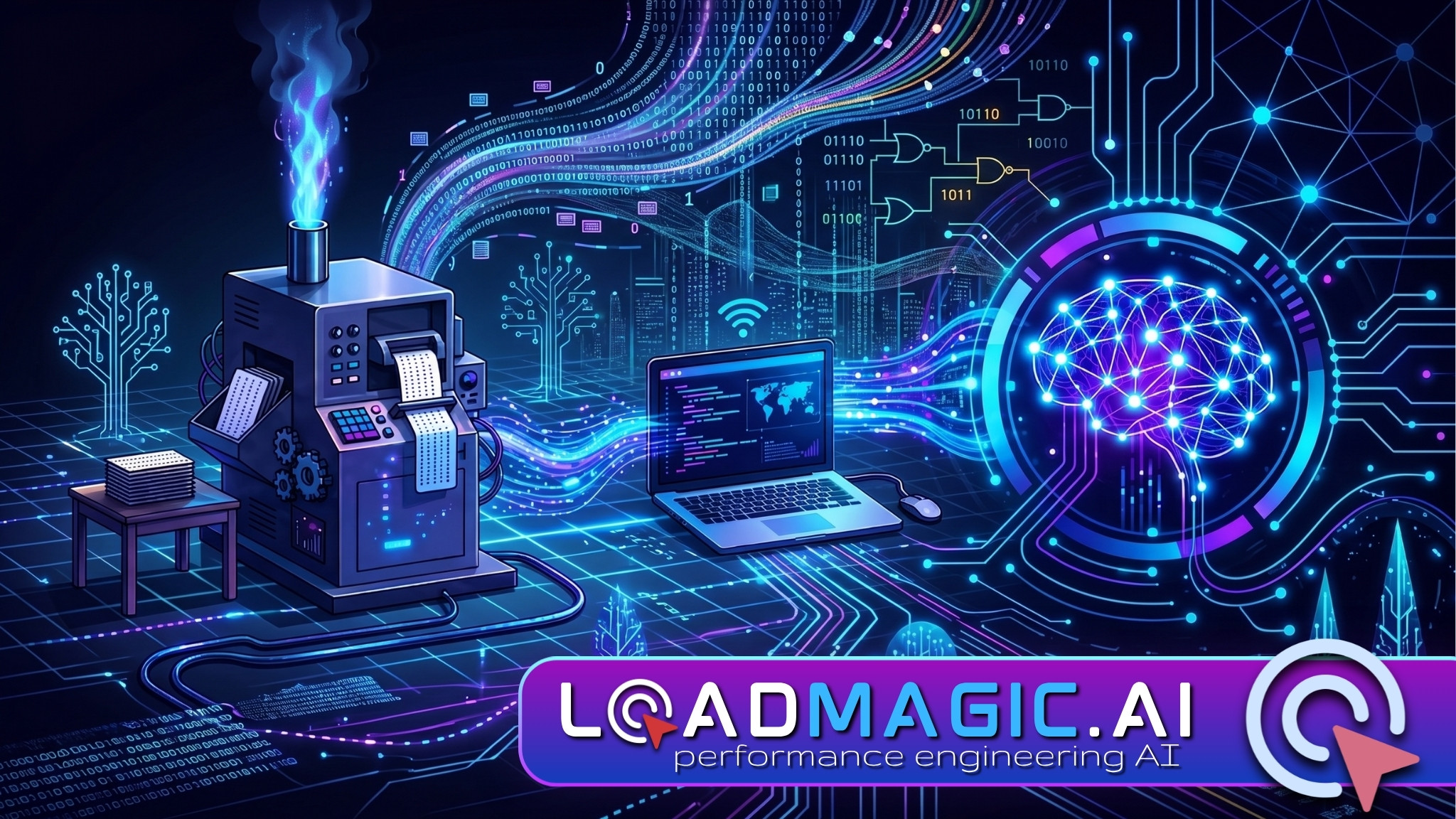
AI performance engineering is the practice of using autonomous AI agents to automate the creation, correlation, validation, and maintenance of software load tests. It replaces hours of manual scripting with minutes of agentic automation, covering the full lifecycle from HTTP recording to production-ready test script.
The term means different things in different contexts. Before going further, it helps to be precise about which meaning applies.
Three meanings of "AI performance engineering"
When someone searches for this phrase, they could be looking for any of three distinct disciplines. They share a name but solve entirely different problems for different audiences.
AI infrastructure tuning
Making AI models run faster on hardware. GPU kernel optimization, CUDA programming, distributed training, memory bandwidth, PyTorch convergence. Practitioners include NVIDIA engineers and the community around Chris Fregly's AI Systems Performance Engineering (O'Reilly, 2025). The goal is faster inference and cheaper training.
AI-assisted QA testing
Bolting LLM prompt interfaces onto existing test management platforms. Vendors like Tricentis, ContextQA, and TestGrid use AI to generate functional test cases, detect visual anomalies, or query test results in natural language. The underlying test execution engine is usually unchanged.
AI-native load test engineering
Purpose-built AI agents that autonomously generate, correlate, validate, and self-heal load test scripts. Handles protocol-level dynamic value extraction, concurrent virtual user simulation, and continuous test maintenance. This is what LoadMagic builds.
The rest of this page is about Lane 3: using agentic AI to solve the hardest, most repetitive parts of performance testing.
Why performance testing needs its own AI approach
Performance testing is fundamentally different from functional testing. Functional tests check whether a feature works. Performance tests check whether a system survives real-world load: thousands of concurrent users, dynamic session tokens, correlated request chains, and response-dependent branching. The tooling problems are different too.
The bottleneck is not writing the first version of a test. It is correlation: the process of identifying dynamic values in HTTP responses (session IDs, tokens, CSRF values, pagination cursors) and wiring extractors so that subsequent requests use the correct values. On a moderately complex application, manual correlation can take 4 to 8 hours of skilled engineering time per recorded flow.
— From a stopwatch time-and-motion study in AI Performance Engineering
The second bottleneck is maintenance. When the application under test changes — a new API version, a renamed field, an added authentication step — existing test scripts break. Manual diagnosis and repair follows the same correlation cycle. AI-native platforms solve this with self-healing: the system detects what broke, compares against a known-good baseline, and fixes the script automatically.
How AI-native load test engineering works
An AI-native platform does not add a chat window to an existing tool. It rebuilds the workflow around specialised AI agents that collaborate on the same test plan. Here is the typical pipeline:
Recording ingestion
Upload a HAR file (browser recording) or an existing JMeter/Locust script. The system parses every request, response header, and body.
Correlation analysis
AI agents scan response bodies for dynamic values, match them against downstream request parameters, and generate extractors (regex, JSON path, boundary) automatically.
Script generation
A complete, runnable load test script is assembled: parameterised requests, extractors, assertions, think times, and transaction boundaries.
Quality validation
A QA agent replays the script, checks for unresolved correlations, validates response codes, and flags structural issues before any load is applied.
Self-healing
When the application changes and the script breaks, the system compares the failed run against the known-good baseline, identifies what changed, and repairs the affected extractors and requests.
Human oversight
Every automated change can be accepted or rejected. The engineer stays in control; the AI handles the repetitive engineering.
Each step is handled by a specialised agent with a defined role. The agents coordinate rather than competing — one correlates, another validates, a third diagnoses failures, and an orchestrator routes tasks to the right specialist.
Traditional scripting vs. AI-native engineering
| Dimension | Traditional manual scripting | AI-native load test engineering |
|---|---|---|
| Correlation | Manual: inspect responses, write regex, test iteratively | Automated: agents scan, extract, and wire correlations in seconds |
| Time to first runnable script | Hours to days per flow | Minutes per flow |
| Maintenance | Re-do correlation when app changes | Self-healing: baseline comparison and automatic repair |
| Skill requirement | Deep tool expertise (JMeter, Gatling, Locust internals) | Performance testing knowledge; tool expertise handled by AI |
| Quality assurance | Manual replay and visual inspection | Automated QA agent with structured pass/fail gates |
| Scalability | Linear: more flows = more engineering hours | Parallel: agents process multiple flows concurrently |
What makes it "agentic" rather than just "AI-assisted"
The distinction matters. AI-assisted tools add a prompt interface to an existing workflow. The engineer still drives every step; the AI suggests or generates fragments. Agentic systems work toward a goal autonomously: they perceive the test state, plan a strategy, execute actions, evaluate the outcome, and adapt — without requiring human input at every step.
In practice, this means:
- Multi-step execution. The agent does not produce one extraction and stop. It processes an entire request chain, resolving dependencies between correlated values across dozens of requests.
- Tool use. Agents call specialised tools (regex builders, JSON path evaluators, HTTP clients) rather than outputting text that a human must copy-paste into a tool.
- Self-correction. When a correlation attempt fails validation, the agent retries with a different extraction strategy rather than surfacing an error for the engineer to solve.
- Delegation. An orchestrator agent routes tasks to the right specialist agent. A diagnostic task goes to the diagnostician; a correlation task goes to the correlator. The right model and the right context for each job.
The God Mode story documents what happened when we gave one agent full autonomous authority — what it took to make it work reliably and what we learned about trust, rollback, and the limits of AI judgement.
The three-layer architecture behind self-healing
Self-healing is not a single feature. It is an architecture built from three coordinated layers:
- Detection. Automated comparison between the current test run and the known-good baseline. The system identifies which requests failed, which extractors returned empty, and which dynamic values changed.
- Diagnosis. An AI agent analyses the failures structurally: is the value genuinely gone (application change), or did the extraction pattern break (regex mismatch)? This prevents the system from "fixing" things that are not broken.
- Repair. Targeted mutations to the test script. The agent rewrites the affected extractors, updates request parameters, and re-validates. Every repair is reversible — accept or reject with one click.
This architecture is covered in depth in Why Correlation Needs Three Layers and chapters 3 and 8 of the book.
The evidence
Claims without measurement are marketing. Here is what we have published:
- The 20x Claim, Audited — a stopwatch time-and-motion study comparing manual correlation against AI-native automation across multiple flow complexities, with methodology, raw data, and honest limitations.
- Self-Healing Performance Tests — how the three-layer architecture works in practice, with examples of real script failures detected, diagnosed, and repaired autonomously.
- How Five Agents Fix Correlation — the specialised agent roles and how they coordinate on a single test plan.
- AI Performance Engineering (the book) — 140 pages of architecture decisions, workflow data, and honest analysis. Free sample available.
Choosing your approach
AI-native load test engineering is one of four ways to add AI to your testing workflow. The right choice depends on your team size, existing tooling, security requirements, and where your bottleneck actually is. Chapter 9 of the book compares all four approaches — open-source plugins, cloud API services, purpose-built platforms, and enterprise VPC deployments — with honest trade-offs for each.
If your team spends most of its time on correlation and script maintenance, an AI-native platform will have the highest impact. If your bottleneck is elsewhere (test design, infrastructure provisioning, results analysis), a lighter-weight approach may be sufficient.
Explore further
The Book
AI Performance Engineering — the first practical guide to AI-powered load testing. Architecture, evidence, and a blueprint for building your own pipeline.
How Five Agents Fix Correlation
Meet George, Carrie, Rupert, Suzy, and Quinn — the specialised agents behind LoadMagic's correlation pipeline.
The 20x Claim, Audited
A stopwatch study comparing manual vs. AI correlation. Raw data, methodology, and honest limitations.
Self-Healing Performance Tests
How the three-layer architecture detects, diagnoses, and repairs broken test scripts automatically.
The God Mode Story
What happened when we gave one agent full autonomous authority — and what it took to make it reliable.
Why Correlation Needs Three Layers
The architectural decisions behind detection, diagnosis, and repair — and why a single-pass approach fails.